
Network Rail is responsible for delivering reliable travel services to the millions of commuters who utilise Europe’s fastest-growing railway every day. As well as the vast number of commuters that Network Rail supports, the not-for-profit organisation is also an essential component of many business supply chains.
For example, along Network Rail’s freight lines, huge quantities of materials such as grit and sand are transported all over the UK. During this transportation, it is common for vehicles to leak small quantities of grit across the tracks whilst they’re in transit.
Cranks & Grit Leaks
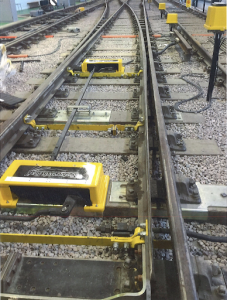
This leaking can become a serious issue. Throughout contemporary railways, cranks are utilised to shift tracks from one line to another – thus allowing trains to access different lines and thus reach different destinations. Leaked grit can wreak havoc on these cranks, which, as one can imagine, is at best very inconvenient, or at worst potentially very dangerous.
In order to combat the crank degradation caused by grit and sand leaks, Network Rail deployed various measures such as CCTV to monitor freight cargo and crank operation, as well as improving the sealing within the carriages which transport said grit and sand. Whilst effective, these measures did not completely solve the problem.
The Third Line of Defence
As such, Network Rail enlisted the services of Cox Wokingham to develop the third line of defence to better protect the cranks in operation throughout the enormous network of tracks under the responsibility of the organisation.
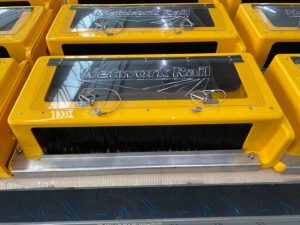
Cox Wokingham began the close working partnership with Network Rail by first seeking to understand precisely what was required in order to make the project a success. In order to effectively combat leaked grit and sand from seeping into the cranks, it became clear that a functional cover would need to be designed and installed. However, this cover would not only have to keep out grit, but it would also have to consistently withstand the extremely testing conditions that components operating across rail networks are subjected to.
Off the back of these initial discussions, and with the unique requirements in mind, specialist Cox Wokingham designers began formulating a product which could effectively stop grit from getting into rail cranks.